What I will be doing this weekend (Friday evening until Sunday mid-afternoon, that is):
HEALING THE EARTH, NOURISHING OURSELVES: Growing, Eating & Preparing Food Locally
Come join Andrew Faust, one of the premier Permaculture teachers in North America, from The Center For Bioregional Living in New York City and Ellenville, NY.
This course will cover how to design abundant and productive local food systems using Permaculture and offer a series of fun, hands-on, food-oriented activities.
Topics include: Local and seasonal foods and their preparation; Extending and over-wintering your backyard or container garden; Growing indoors and fermented foods; Eating right for your region, season and vitality.
Demonstration and hands-on activities will include:
-Lacto-fermention -- kim chee, sauerkraut, etc.
-Water-bath canning of seasonal local tomatoes *
-Root cellaring
-Solar drying
-Culturing raw dairy*
-Sprouting
-Inoculating and baking sour dough bread!*
-Designs and techniques of mushroom cultivation: return home with an inoculated log!
Come and learn how to live well and in harmony with the earth while boosting immunity and increasing longevity!
*Bring a wide mouth pint jar if you would like to take home some sourdough starter. Please also bring a few 1 qt. glass mason jars if you would like bring home some fermented foods.
(It's happening here.) I am not sure I am brave enough for homemade yogurt, but I am totally up for canning tomatoes and making pickles and sourdough. If I liked mushrooms, I'd be psyched about growing them, too. Does anyone want my inoculated log?
Showing posts with label travel. Show all posts
Showing posts with label travel. Show all posts
Sunday, July 12, 2009
Pictures, I have pictures!
First are some photos of the epic, 2.5-hour hike CJ and I took last weekend in the Mohawk Trail State Park. Epic only because we had not planned to be hiking for more than an hour or so, but the map we were given was terrible and the paths pretty much not marked at all. Anyway, it was a gorgeous day! See several photos here. My favorite one:

More recently, I did another bike ride to Hatfield, which I do as a nice-weather substitute for the gym, so I try to bike pretty hard (for me) and far (again, for me). This time I finally found a non-tresspassy way to the dyke and the Connecticut River. Photo set is here, and here's a nice representative shot:

Those two photos are pretty similar. Huh. (Armchair analysts, what does it mean? Don't tell me unless it's something good.)
I have been trying to spend plenty of time outside, now that it's stopped being 60 degrees and raining. I am actually typing this on my screened in porch, surrounded by ecstatic cats, a lovely breeze, and the sounds of birds, windchimes, and motorcycles on the highway.
First are some photos of the epic, 2.5-hour hike CJ and I took last weekend in the Mohawk Trail State Park. Epic only because we had not planned to be hiking for more than an hour or so, but the map we were given was terrible and the paths pretty much not marked at all. Anyway, it was a gorgeous day! See several photos here. My favorite one:

More recently, I did another bike ride to Hatfield, which I do as a nice-weather substitute for the gym, so I try to bike pretty hard (for me) and far (again, for me). This time I finally found a non-tresspassy way to the dyke and the Connecticut River. Photo set is here, and here's a nice representative shot:
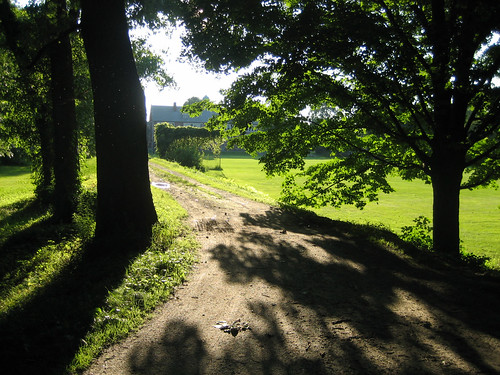
Those two photos are pretty similar. Huh. (Armchair analysts, what does it mean? Don't tell me unless it's something good.)
I have been trying to spend plenty of time outside, now that it's stopped being 60 degrees and raining. I am actually typing this on my screened in porch, surrounded by ecstatic cats, a lovely breeze, and the sounds of birds, windchimes, and motorcycles on the highway.
Monday, March 09, 2009
Final Belize post! Here it is! For reals!
So, the day after our Tikal-touring day, we had a long journey to Caye Caulker, which culminated in an hour-long water taxi ride in the rain. Actually, it stopped raining just before we boarded, luckily. But the water was still super-choppy, which I had been scared to death of, but the Bonine worked its magic. We stepped off the boat and retrieved our luggage from where the sailors had hauled it onto the dock, and we walked a long way to our hotel, Shirley's Guest House. It was very windy and somewhat chilly.
It did not look like this at the time (since this photo was taken at a sunny time), but this is part of Shirley's yard:

I had read that she had a dock you could swim from, like most of the other beach-side hotels. But when I asked Shirley, she non-chalantly said, "after the second time a storm took it down, I decided not to rebuild it again." I was a bit miffed, but what can you do?
Here's the back entrance to Shirley's. When you walked there after dusk, you'd here loud clicking and clacking noises from the huge land crabs walking around in the fallen palm fronds:

I'm just going to sum up our three days on Caye Caulker. It was freakishly cold (which here meant temps down to the 50s at night) with scattered showers and gusty wind for much of the time. We had two full days to work with, so we put off our snorkeling adventure for the second day, which ended up being a good bet. Besides the snorkeling, we spent a lot of time just wandering around the town, up and down the sand streets, then going back to our room for a nap, then going out again to eat. I remember feeling sad that I had to wait a few hours before I could reasonably eat another meal.
We bought some reasonably good sweetened bread at the bakery on the right:

Here's another street, this time in the sun:

Here's the shoreline. Lots of mangroves; a lot of the island is mangrove swamp, though it's slowly being build into. That white blob is a great egret; there were many wading birds about. You can't really swim directly from the shore, as there's a lot of sea grass and stuff you don't want to step on.

On one of the days we rented some crappy bikes, which were guarded by this fierce dog.

The bikes made getting from one end of the island to the other a lot quicker. Shirley's is pretty much at the southern end of the inhabited part. At the northern part is The Split, a channel in the island that was created during Hurricane Hattie. There's still the remains of a cement road there. I think I took this photo from the split, looking south:

We ate a lot of good food there, but I think the best meal was at Rose's. They have the fish (caught that day, of course) all laid out at the entrance, and you choose which one you want:

Shish kabobs were $10, the snapper were $20-30, depending on size, and the lobsters were $30. That's in Belize, so in American dollars, it's half that price. Once you pick your fish, the guy slices it open, rubs some seasoning on it, and throws it on the grill. Meanwhile you sit down and order a couple of side dishes (which are included in the price) and a Belikin beer (if you're smart). It was pouring rain the night we went here, and like most of the restaurants here, all of the seating was open to the air (though covered). But it didn't matter. We got a snapper and a lobster and shared them. So. Fuckin'. Good.
It took us a while to decide upon what snorkeling trip we wanted to do. By "we" I mean "me," because it was not getting any less windy and wavey out there, and I was petrified of being stuck on a boat for several hours while throwing up pretty much non-stop. I came very close to not going at all, figuring the stress wasn't worth it. But I finally got over myself, and we went with a "full day" snorkel trip to Shark-ray Alley, the Hol Chan Marine Reserve, and the Coral Gardens. "Full day" just means 10 to 4, by the way, and includes an hour or so stop for lunch at the larger Caye to the north, Ambergris.
The boat trip to the reef action was insanely bumpy, but I didn't get sick at all (again, thank you god for Bonine). It was seriously so bumpy that people were laughing at how hard the boat would slam down onto the water when it skipped off the top of a wave. The first stop was Shark-Ray Alley, and there were many huge rays about, but no sharks. The water wasn't very cold, though getting out and being in the wind was no picnic. The second stop was Hol Chan, which had sharks -- nurse sharks, which are like overgrown catfish, really. The tour leader had thoughtfully brought a small container of chum for the sharks, who swam right up to the edge of the boat as soon as he cut the engines. Here's one begging for a treat:

I hopped in soon after taking that photo and got to pet a baby shark, who seemed to actually enjoy the attention, like a slippery puppy. Cute.
We saw many incredible fish and coral, but I don't have an underwater camera, so you'll have to close your eyes and imagine. Or go to YouTube and search for "Hol Chan" or something.
After Hol Chan we motored over to San Pedro, the main city on Ambergris Caye. We docked on "Bottom Time"'s pier:

You can see it's more upscale and built up than Caulker. Here's a San Pedro street scene, on an actual paved road, with two actual yellow-dyed poodles:

We got cheap, greasy (but tasty) tamales at a counter place and ate them on a beautiful deck on the beach. Then we met at the boat and were taken to Coral Gardens, which was pretty much the same as Hol Chan, except no sharks. Apparently there used to be more sharks around but climate change has fucked with their habitat.
Anyway, we returned to Caye Caulker safely, and the day afterwards, we went home to New England. It was a lovely trip.
So, the day after our Tikal-touring day, we had a long journey to Caye Caulker, which culminated in an hour-long water taxi ride in the rain. Actually, it stopped raining just before we boarded, luckily. But the water was still super-choppy, which I had been scared to death of, but the Bonine worked its magic. We stepped off the boat and retrieved our luggage from where the sailors had hauled it onto the dock, and we walked a long way to our hotel, Shirley's Guest House. It was very windy and somewhat chilly.
It did not look like this at the time (since this photo was taken at a sunny time), but this is part of Shirley's yard:
I had read that she had a dock you could swim from, like most of the other beach-side hotels. But when I asked Shirley, she non-chalantly said, "after the second time a storm took it down, I decided not to rebuild it again." I was a bit miffed, but what can you do?
Here's the back entrance to Shirley's. When you walked there after dusk, you'd here loud clicking and clacking noises from the huge land crabs walking around in the fallen palm fronds:
I'm just going to sum up our three days on Caye Caulker. It was freakishly cold (which here meant temps down to the 50s at night) with scattered showers and gusty wind for much of the time. We had two full days to work with, so we put off our snorkeling adventure for the second day, which ended up being a good bet. Besides the snorkeling, we spent a lot of time just wandering around the town, up and down the sand streets, then going back to our room for a nap, then going out again to eat. I remember feeling sad that I had to wait a few hours before I could reasonably eat another meal.
We bought some reasonably good sweetened bread at the bakery on the right:
Here's another street, this time in the sun:
Here's the shoreline. Lots of mangroves; a lot of the island is mangrove swamp, though it's slowly being build into. That white blob is a great egret; there were many wading birds about. You can't really swim directly from the shore, as there's a lot of sea grass and stuff you don't want to step on.
On one of the days we rented some crappy bikes, which were guarded by this fierce dog.
The bikes made getting from one end of the island to the other a lot quicker. Shirley's is pretty much at the southern end of the inhabited part. At the northern part is The Split, a channel in the island that was created during Hurricane Hattie. There's still the remains of a cement road there. I think I took this photo from the split, looking south:
We ate a lot of good food there, but I think the best meal was at Rose's. They have the fish (caught that day, of course) all laid out at the entrance, and you choose which one you want:
Shish kabobs were $10, the snapper were $20-30, depending on size, and the lobsters were $30. That's in Belize, so in American dollars, it's half that price. Once you pick your fish, the guy slices it open, rubs some seasoning on it, and throws it on the grill. Meanwhile you sit down and order a couple of side dishes (which are included in the price) and a Belikin beer (if you're smart). It was pouring rain the night we went here, and like most of the restaurants here, all of the seating was open to the air (though covered). But it didn't matter. We got a snapper and a lobster and shared them. So. Fuckin'. Good.
It took us a while to decide upon what snorkeling trip we wanted to do. By "we" I mean "me," because it was not getting any less windy and wavey out there, and I was petrified of being stuck on a boat for several hours while throwing up pretty much non-stop. I came very close to not going at all, figuring the stress wasn't worth it. But I finally got over myself, and we went with a "full day" snorkel trip to Shark-ray Alley, the Hol Chan Marine Reserve, and the Coral Gardens. "Full day" just means 10 to 4, by the way, and includes an hour or so stop for lunch at the larger Caye to the north, Ambergris.
The boat trip to the reef action was insanely bumpy, but I didn't get sick at all (again, thank you god for Bonine). It was seriously so bumpy that people were laughing at how hard the boat would slam down onto the water when it skipped off the top of a wave. The first stop was Shark-Ray Alley, and there were many huge rays about, but no sharks. The water wasn't very cold, though getting out and being in the wind was no picnic. The second stop was Hol Chan, which had sharks -- nurse sharks, which are like overgrown catfish, really. The tour leader had thoughtfully brought a small container of chum for the sharks, who swam right up to the edge of the boat as soon as he cut the engines. Here's one begging for a treat:
I hopped in soon after taking that photo and got to pet a baby shark, who seemed to actually enjoy the attention, like a slippery puppy. Cute.
We saw many incredible fish and coral, but I don't have an underwater camera, so you'll have to close your eyes and imagine. Or go to YouTube and search for "Hol Chan" or something.
After Hol Chan we motored over to San Pedro, the main city on Ambergris Caye. We docked on "Bottom Time"'s pier:
You can see it's more upscale and built up than Caulker. Here's a San Pedro street scene, on an actual paved road, with two actual yellow-dyed poodles:
We got cheap, greasy (but tasty) tamales at a counter place and ate them on a beautiful deck on the beach. Then we met at the boat and were taken to Coral Gardens, which was pretty much the same as Hol Chan, except no sharks. Apparently there used to be more sharks around but climate change has fucked with their habitat.
Anyway, we returned to Caye Caulker safely, and the day afterwards, we went home to New England. It was a lovely trip.
Monday, February 23, 2009
The day after our day of wandering around the San Ignacio area, we packed up and took a cab to the Guatemalan border. We had arranged a driver to pick us up on the other side. We had to pay about $30 in various fees and taxes to leave, and got our passports stamped twice. Here's the scene on the Guatemalan side; lots of taxi drivers waiting, and money-changers wearing fanny packs (they ended up being legit), with a few cops wearing semi-automatic weapons.

The roads in Guatemala are way worse than the ones in Belize; tons of huge potholes and ruts, and cars slow to a creep in order to traverse them. The trip to Tikal from the border took about an hour and a half. About halfway through our driver stopped at a very nice and clean and way overpriced tourist shop which also had bathrooms and free coffee. Parked at the house next to the shop was this car:

(It refers to the end of the Mayan calendar, which some think means the end of the world, or the time the aliens will finally come to collect us, or something.)
The Tikal ruins are in the middle of a huge nature reserve, so they have a lot of animal crossing signs: turkeys, snakes, coati, and of course jaguar:

Our hotel was the Jaguar Inn, one of the three right at the entrance gate to the ruins themselves. It was kind of like Midas -- very jungly, but even moreso since we were in the middle of a reserve. In fact, the power is from a generator that they shut off every night at 9, and hot water is only available a few hours a day.
Here's a path to the dining patio:

We put our stuff in our room and got lunch and watched some toucans while we ate. There's one in the middle of this photo:

Then it was time to do the ruins. At the gate we decided to save the $50 a guide would have cost, and bought a guide map for a few bucks instead. It takes about 10 minutes to get to the beginning of the ruins, and then a half-hour to get to Temple IV (which is what our guidebook suggested). The paths are well maintained and travel through serious jungle. Before we reached Temple IV we passed a bunch of smaller structures -- Tikal is enormous -- and so we looked to the map to explain what we were looking at. That is when we discovered that we should have sprung for the guide. Here's what it says about the first ruins we passed, Complex Q:
"This complex of twin pyramids is the biggest constructed in Tikal. To the north of its square there is located an enclosure inside which one finds the complex alter - stela. To the side south, a structure is located with nine income and at the head of the placed pyramid eastwards, nine stelas and smooth altars. The monuments esculpidos dedicatory for this complex are the Estela 22 and the Altar 10 that date the end of the katun of 771 Classic Late and there were constructed by the leader 29, Yax Nuun Ayin II."
(The map also gave "recommendations to enjoy his visit" such as "To behave for qualified paths, not to take paths it does not know." And "It uses the accesses authorized to rise and to get off only the structures." And "leads 45 kph and avoids to knock down the wild fauna. It takes to himself record of his speed.")
So yeah, we pretty much gave up on trying to glean any information from the map besides where things were. We did eavesdrop on another group's guide a couple of times, which was nice.
Anyway, on to the photos:
Here's the aforementioned Complex Q:

And this is Temple IV peeking out of the canopy; it's in the process of being restored, thus the scaffolding. The six big temples had wooden stairways to use to get to the top, instead of letting you use the steep, railing-free stone steps (which they used to do, apparently). Those signs say stuff about how you have to walk around to the side of the temple to climb up:

And the view from Temple IV:

It is high. Those are some big-ass trees, and the temples just rise right up above them!
Near the base of Temple IV was a rest area with actual bathrooms and even a little soda-selling counter. You can see it in the background here, with a pretty wild turkey hanging around in the foreground:

There was also a coati, which is like a raccoon; it was searching for tidbits in the leaf litter near a trash can, and was totally ignoring all of the tourists taking photos of it:

We were EXPLORING!

(That's CJ on Mundo Perdido.)
The main attraction at Tikal is the grand plaza, which has two big temples and a ton of smaller buildings, full of little rooms to explore. The coolest-looking temple is Temple I, which you're no longer allowed to climb. This shot is taken from the top of Temple II, just across from it:

Temple I from the side, showing some of the Acropolis in the background. There are little people there, for scale:

I captioned this photo with Central Acropolis but I think it's the North Acropolis. But I really don't know for sure:

From, um, one of the Acropoli, we could see Temple V rising up in the distance, which reminded me of the shot of Endor they filmed here (from Return of the Jedi, OF COURSE):

We did a LOT of walking and climbing but I had heard Temple V was the most insane, so we went. We didn't see anybody there, or on the way there or back. Here's the approach to Temple V:

What's insane about Temple V is the way up: A rickety-looking staircase that's so steep it's really more of a ladder. A seven-story-tall ladder.

I was not going to not climb this. DAMMIT, WE HAD COME TOO FAR. So we did. At the top, of course, there was no railing or anything to stop us from slipping and tumbling forward down the steep stone steps. Here's the view from the top:

The climb down was much scarier. We climbed down backwards like we were descending a ladder. Note the angle of the stairway railing, and how very acute it is:

Whew.
After that we went back to the entrance and explored our dinner options at the other two hotels. Not great. While we were peering through the twilight underbrush at a gibnut (we had no idea what it was at the time, but it looked like a cat-sized capybara), a guy in his late 50s or so started talking to us. He said that he had heard the cheap place near the campsites was supposed to have authentic local food, which would be a huge step up from the weird American-diner-like mixture offered by the hotels. So we ended up meeting up with him and hearing about his interesting life as an ex-Earth Firster who had spent some time in the clink, but who now just travels most of the time (possibly financed by his wealthy son). He was a friendly and intriguing guy, and he generously bought us beers, but at the end we decided that one of the reasons he liked traveling around third-world countries so much is that it enabled him to be rude to the waitstaff without any consequence.
The power did in fact go off at 9, and I had a hard time falling asleep without my sound machine (such a delicate flower I am). And then we had to get up and catch our ride at 8 the next morning, so we could get dropped off at the Guatemalan border, take a cab back to Midas, meet a shuttle van there at 12:15, and then get driven an hour and a half or so to Belize City, where we would catch the water taxi for the 45-minute-ride to Caye Caulker. But that's for the next post.
The roads in Guatemala are way worse than the ones in Belize; tons of huge potholes and ruts, and cars slow to a creep in order to traverse them. The trip to Tikal from the border took about an hour and a half. About halfway through our driver stopped at a very nice and clean and way overpriced tourist shop which also had bathrooms and free coffee. Parked at the house next to the shop was this car:
(It refers to the end of the Mayan calendar, which some think means the end of the world, or the time the aliens will finally come to collect us, or something.)
The Tikal ruins are in the middle of a huge nature reserve, so they have a lot of animal crossing signs: turkeys, snakes, coati, and of course jaguar:
Our hotel was the Jaguar Inn, one of the three right at the entrance gate to the ruins themselves. It was kind of like Midas -- very jungly, but even moreso since we were in the middle of a reserve. In fact, the power is from a generator that they shut off every night at 9, and hot water is only available a few hours a day.
Here's a path to the dining patio:
We put our stuff in our room and got lunch and watched some toucans while we ate. There's one in the middle of this photo:
Then it was time to do the ruins. At the gate we decided to save the $50 a guide would have cost, and bought a guide map for a few bucks instead. It takes about 10 minutes to get to the beginning of the ruins, and then a half-hour to get to Temple IV (which is what our guidebook suggested). The paths are well maintained and travel through serious jungle. Before we reached Temple IV we passed a bunch of smaller structures -- Tikal is enormous -- and so we looked to the map to explain what we were looking at. That is when we discovered that we should have sprung for the guide. Here's what it says about the first ruins we passed, Complex Q:
"This complex of twin pyramids is the biggest constructed in Tikal. To the north of its square there is located an enclosure inside which one finds the complex alter - stela. To the side south, a structure is located with nine income and at the head of the placed pyramid eastwards, nine stelas and smooth altars. The monuments esculpidos dedicatory for this complex are the Estela 22 and the Altar 10 that date the end of the katun of 771 Classic Late and there were constructed by the leader 29, Yax Nuun Ayin II."
(The map also gave "recommendations to enjoy his visit" such as "To behave for qualified paths, not to take paths it does not know." And "It uses the accesses authorized to rise and to get off only the structures." And "leads 45 kph and avoids to knock down the wild fauna. It takes to himself record of his speed.")
So yeah, we pretty much gave up on trying to glean any information from the map besides where things were. We did eavesdrop on another group's guide a couple of times, which was nice.
Anyway, on to the photos:
Here's the aforementioned Complex Q:
And this is Temple IV peeking out of the canopy; it's in the process of being restored, thus the scaffolding. The six big temples had wooden stairways to use to get to the top, instead of letting you use the steep, railing-free stone steps (which they used to do, apparently). Those signs say stuff about how you have to walk around to the side of the temple to climb up:
And the view from Temple IV:
It is high. Those are some big-ass trees, and the temples just rise right up above them!
Near the base of Temple IV was a rest area with actual bathrooms and even a little soda-selling counter. You can see it in the background here, with a pretty wild turkey hanging around in the foreground:
There was also a coati, which is like a raccoon; it was searching for tidbits in the leaf litter near a trash can, and was totally ignoring all of the tourists taking photos of it:
We were EXPLORING!
(That's CJ on Mundo Perdido.)
The main attraction at Tikal is the grand plaza, which has two big temples and a ton of smaller buildings, full of little rooms to explore. The coolest-looking temple is Temple I, which you're no longer allowed to climb. This shot is taken from the top of Temple II, just across from it:
Temple I from the side, showing some of the Acropolis in the background. There are little people there, for scale:
I captioned this photo with Central Acropolis but I think it's the North Acropolis. But I really don't know for sure:
From, um, one of the Acropoli, we could see Temple V rising up in the distance, which reminded me of the shot of Endor they filmed here (from Return of the Jedi, OF COURSE):
We did a LOT of walking and climbing but I had heard Temple V was the most insane, so we went. We didn't see anybody there, or on the way there or back. Here's the approach to Temple V:
What's insane about Temple V is the way up: A rickety-looking staircase that's so steep it's really more of a ladder. A seven-story-tall ladder.
I was not going to not climb this. DAMMIT, WE HAD COME TOO FAR. So we did. At the top, of course, there was no railing or anything to stop us from slipping and tumbling forward down the steep stone steps. Here's the view from the top:
The climb down was much scarier. We climbed down backwards like we were descending a ladder. Note the angle of the stairway railing, and how very acute it is:
Whew.
After that we went back to the entrance and explored our dinner options at the other two hotels. Not great. While we were peering through the twilight underbrush at a gibnut (we had no idea what it was at the time, but it looked like a cat-sized capybara), a guy in his late 50s or so started talking to us. He said that he had heard the cheap place near the campsites was supposed to have authentic local food, which would be a huge step up from the weird American-diner-like mixture offered by the hotels. So we ended up meeting up with him and hearing about his interesting life as an ex-Earth Firster who had spent some time in the clink, but who now just travels most of the time (possibly financed by his wealthy son). He was a friendly and intriguing guy, and he generously bought us beers, but at the end we decided that one of the reasons he liked traveling around third-world countries so much is that it enabled him to be rude to the waitstaff without any consequence.
The power did in fact go off at 9, and I had a hard time falling asleep without my sound machine (such a delicate flower I am). And then we had to get up and catch our ride at 8 the next morning, so we could get dropped off at the Guatemalan border, take a cab back to Midas, meet a shuttle van there at 12:15, and then get driven an hour and a half or so to Belize City, where we would catch the water taxi for the 45-minute-ride to Caye Caulker. But that's for the next post.
Monday, February 16, 2009
On to Xunantunich! You pronounce it "zoo-nahn-too-niche." You're welcome, I am sure it'll come in handy. The day after the cave tubing and the zoo, we had wanted to spend the morning wandering around town and the afternoon horseback-riding through the countryside, maybe stopping at a gorgeous swimming hole along the way. That didn't happen; the horse person the resort owner liked was on vacation, and they had a hard time getting in touch with the other one they liked, and when they reached a third place, the price they quoted was ridiculous. So the owner gave us a good alternative plan: Take a cab to the top of Xunantunich (which is on top of a small mountain), walk around, then walk down the hill to the river crossing, and grab a cab. Instruct the cab to take you to the Cahal Pech ruin, and after touring that, walk up the hill to the Cahal Pech Resort, where you can pay $2.50 to use the pool for the day. Then it's an easy walk back to Midas.
Well, the first part of the plan worked great. After a relaxed breakfast in town, we took a cab up to the Xunantunich ruins — which involves crossing the river via hand-cranked ferry. Here's the ferryman:

And here's the ferry, from the other side, taken on the way back. A note here about my photos: Up until this point, actually when I was on top of the pyramid here, I hadn't realized that the light setting on my camera was set to "incandescent light" -- which is why everything beforehand is blue and washed out. I did a lot of work on adjusting the levels in Photoshop, but there's only so much I can do. My photos got a LOT better after I changed it to natural light.

Here's the approach to the main plaza:

The main pyramid, El Castilo. You can climb to the top and all around. Very exciting. No guard rails anywhere.

One of the stairways leading to the top:

A view from the top:

There are two carved friezes on the Castilo, here's one:

And here's a close-up of the other:

The archeologists found three carved slabs called stelae here, and they now live in a little house to protect them from the elements.

I liked the ceiling, which is like a wooden stave church from Norway (well, like the one in Epcot, at any rate. Heh).

Afterwards, we walked the mile down the hill to the bottom, caught a cab to the ruins of Cahal Pech. (Catching a cab = waving down a beat-up car that happens to have "TAXI" painted on the side, and that already has two passengers -- one of them was a guy going to his job at the Cahal Pech resort.) But by the time we got to the second set of ruins, the notion of paying another fee to walk around more ruins was not very appealing. We walked up to the hotel instead and paid our fee to lounge around the pool. The hotel is on top of a hill and it was windy up there; though we had been hot before, we were a bit too cold to swim. It was not too cold to lie around in our bathing suits, though. Eventually we decided to get a snack there, and our waiter was the guy from our taxi! CJ got a delicious mudslide, and I got a nauseating Mai Tai which seemed to be mostly cough syrup. We split some quesadillas too, which were tasty.
Here's a look at the pool. The round one in the foreground is not a hot tub; we were disappointed. I got in up to my waist:

And here's the view of San Ignacio from the pool patio:

Then we walked down into town. We had heard about an iguana sanctuary at a hotel on the way, but it was closed for the evening. So we kept walking. And walking. It was a very long way -- at least 2 miles -- back to Midas. But we can now say that we have seen most of San Ignacio.
Next time: Guatemala and Tikal!
Well, the first part of the plan worked great. After a relaxed breakfast in town, we took a cab up to the Xunantunich ruins — which involves crossing the river via hand-cranked ferry. Here's the ferryman:
And here's the ferry, from the other side, taken on the way back. A note here about my photos: Up until this point, actually when I was on top of the pyramid here, I hadn't realized that the light setting on my camera was set to "incandescent light" -- which is why everything beforehand is blue and washed out. I did a lot of work on adjusting the levels in Photoshop, but there's only so much I can do. My photos got a LOT better after I changed it to natural light.
Here's the approach to the main plaza:
The main pyramid, El Castilo. You can climb to the top and all around. Very exciting. No guard rails anywhere.
One of the stairways leading to the top:
A view from the top:
There are two carved friezes on the Castilo, here's one:
And here's a close-up of the other:
The archeologists found three carved slabs called stelae here, and they now live in a little house to protect them from the elements.
I liked the ceiling, which is like a wooden stave church from Norway (well, like the one in Epcot, at any rate. Heh).
Afterwards, we walked the mile down the hill to the bottom, caught a cab to the ruins of Cahal Pech. (Catching a cab = waving down a beat-up car that happens to have "TAXI" painted on the side, and that already has two passengers -- one of them was a guy going to his job at the Cahal Pech resort.) But by the time we got to the second set of ruins, the notion of paying another fee to walk around more ruins was not very appealing. We walked up to the hotel instead and paid our fee to lounge around the pool. The hotel is on top of a hill and it was windy up there; though we had been hot before, we were a bit too cold to swim. It was not too cold to lie around in our bathing suits, though. Eventually we decided to get a snack there, and our waiter was the guy from our taxi! CJ got a delicious mudslide, and I got a nauseating Mai Tai which seemed to be mostly cough syrup. We split some quesadillas too, which were tasty.
Here's a look at the pool. The round one in the foreground is not a hot tub; we were disappointed. I got in up to my waist:
And here's the view of San Ignacio from the pool patio:
Then we walked down into town. We had heard about an iguana sanctuary at a hotel on the way, but it was closed for the evening. So we kept walking. And walking. It was a very long way -- at least 2 miles -- back to Midas. But we can now say that we have seen most of San Ignacio.
Next time: Guatemala and Tikal!
Continuing in the same vein, I have a few shots of our hotel. It's actually called a "resort" but it's pretty much motel-level lodgings in a gorgeous natural setting. We stayed in one of the single-room cabanas.
The signs at the entrance:

CJ and a dog (there were three) at the Midas office. Behind the little gate is the office where we spent a bunch of time arranging our day trips with Marie, one of the co-owners.

Cement pathways out back lead to the various cabanas and cabins. There's a patch of ground for campers, too.

Midas had three dogs (I think) living there. Like all of the dogs we saw, they lived entirely outdoors and were not spayed or neutered. This one got a nasty gash on an ear one night, which was not treated in any way I could see. Other than that, they seemed to be in dog heaven.

This is one of the three dogs at our hotel. She has oddly-splayed-out front legs, kind of like a dachshunds', though she is labrador-sized. Like the other dogs, she was friendly and well-behaved.

The signs at the entrance:
CJ and a dog (there were three) at the Midas office. Behind the little gate is the office where we spent a bunch of time arranging our day trips with Marie, one of the co-owners.
Cement pathways out back lead to the various cabanas and cabins. There's a patch of ground for campers, too.
Midas had three dogs (I think) living there. Like all of the dogs we saw, they lived entirely outdoors and were not spayed or neutered. This one got a nasty gash on an ear one night, which was not treated in any way I could see. Other than that, they seemed to be in dog heaven.
This is one of the three dogs at our hotel. She has oddly-splayed-out front legs, kind of like a dachshunds', though she is labrador-sized. Like the other dogs, she was friendly and well-behaved.
After cave tubing and the zoo, and the long drive back, we napped then walked into town for dinner and then came back, watched TV and fell asleep. Our little cabana had TV, yes! Half of the channels were in English, and we got Comedy Central and Cartoon Network and everything.
I really liked just walking around the town and looking at everything. Here are a bunch of San Ignacio photos. Travelogue to continue next post.
Nescafe! And note the hand-painted stop sign.

Al's Diner, where we did not eat. I bet it would be tasty, though.

Here's a typical meal that we had: white or black beans over white rice, in a kind of mildly-spiced gravy, with a fried fish fillet (though usually we got a piece of chicken), garnished with a fried plantain. Usually there's a scoop of coleslaw on the plate too. The dish in the middle has hot sauce, and CJ has a skinny burrito. And I always got a Belikin (made by Germans in Belize).

A street downtown. We wanted to go horseback riding, but the good affordable people were on vacation or booked, and so we didn't go. Anyway, Easy Rider seemed like a nice company.

This isn't a grocery store, but, relatedly: Pretty much all of the supermarkets in Belize are owned and run by Chinese people. So you find weird Chinglish stuff along with native Belize/Mexican stuff.

We passed this lot for sale every day. I like that they kept the cement staircase up, because, hey, you can use that for the next house, right? This is along a row of shacks like the one you can sort of see past the metal wall. Even shanty-dwellers can realize the dream of owning property.

The house below is atypical because:
It has actual windows, not just wood shutters.
The top part is larger than the bottom part.
There are no dogs in the photograph.
It's also not a one-story house on stilts, with laundry drying on lines underneath the house.

The house on stilts thing was very common. One of our guides said that they use the space like a deck -- it's shady and cool, after all. And if the kid grows up and needs a place to live with their spouse, you can enclose the space and make it the first story of a now-two-story house. None of these placed have running water, by the way, or if they do, they don't have plumbing for toilets/baths. Outhouses don't seem quite so terrible in a climate where it never really gets cold.
And finally, a wall topped with decorative tires.

I really liked just walking around the town and looking at everything. Here are a bunch of San Ignacio photos. Travelogue to continue next post.
Nescafe! And note the hand-painted stop sign.
Al's Diner, where we did not eat. I bet it would be tasty, though.
Here's a typical meal that we had: white or black beans over white rice, in a kind of mildly-spiced gravy, with a fried fish fillet (though usually we got a piece of chicken), garnished with a fried plantain. Usually there's a scoop of coleslaw on the plate too. The dish in the middle has hot sauce, and CJ has a skinny burrito. And I always got a Belikin (made by Germans in Belize).
A street downtown. We wanted to go horseback riding, but the good affordable people were on vacation or booked, and so we didn't go. Anyway, Easy Rider seemed like a nice company.
This isn't a grocery store, but, relatedly: Pretty much all of the supermarkets in Belize are owned and run by Chinese people. So you find weird Chinglish stuff along with native Belize/Mexican stuff.
We passed this lot for sale every day. I like that they kept the cement staircase up, because, hey, you can use that for the next house, right? This is along a row of shacks like the one you can sort of see past the metal wall. Even shanty-dwellers can realize the dream of owning property.
The house below is atypical because:
It has actual windows, not just wood shutters.
The top part is larger than the bottom part.
There are no dogs in the photograph.
It's also not a one-story house on stilts, with laundry drying on lines underneath the house.
The house on stilts thing was very common. One of our guides said that they use the space like a deck -- it's shady and cool, after all. And if the kid grows up and needs a place to live with their spouse, you can enclose the space and make it the first story of a now-two-story house. None of these placed have running water, by the way, or if they do, they don't have plumbing for toilets/baths. Outhouses don't seem quite so terrible in a climate where it never really gets cold.
And finally, a wall topped with decorative tires.
Subscribe to:
Posts (Atom)
